Zillig, K. W., Lassar, S. S., Watson, S. M., Baird, S. E., Schneider, A. D., Fangue, N. A. Comparison of juvenile white sturgeon blade strike survival through a conventional and a novel hydropower turbine.
Journal of Ecohydrology
Download PDF →Photo: National Geographic Photo Ark
Hydropower is essential to a clean energy future, but can we build it in a way that doesn't come at the cost of the world's most imperiled fish?
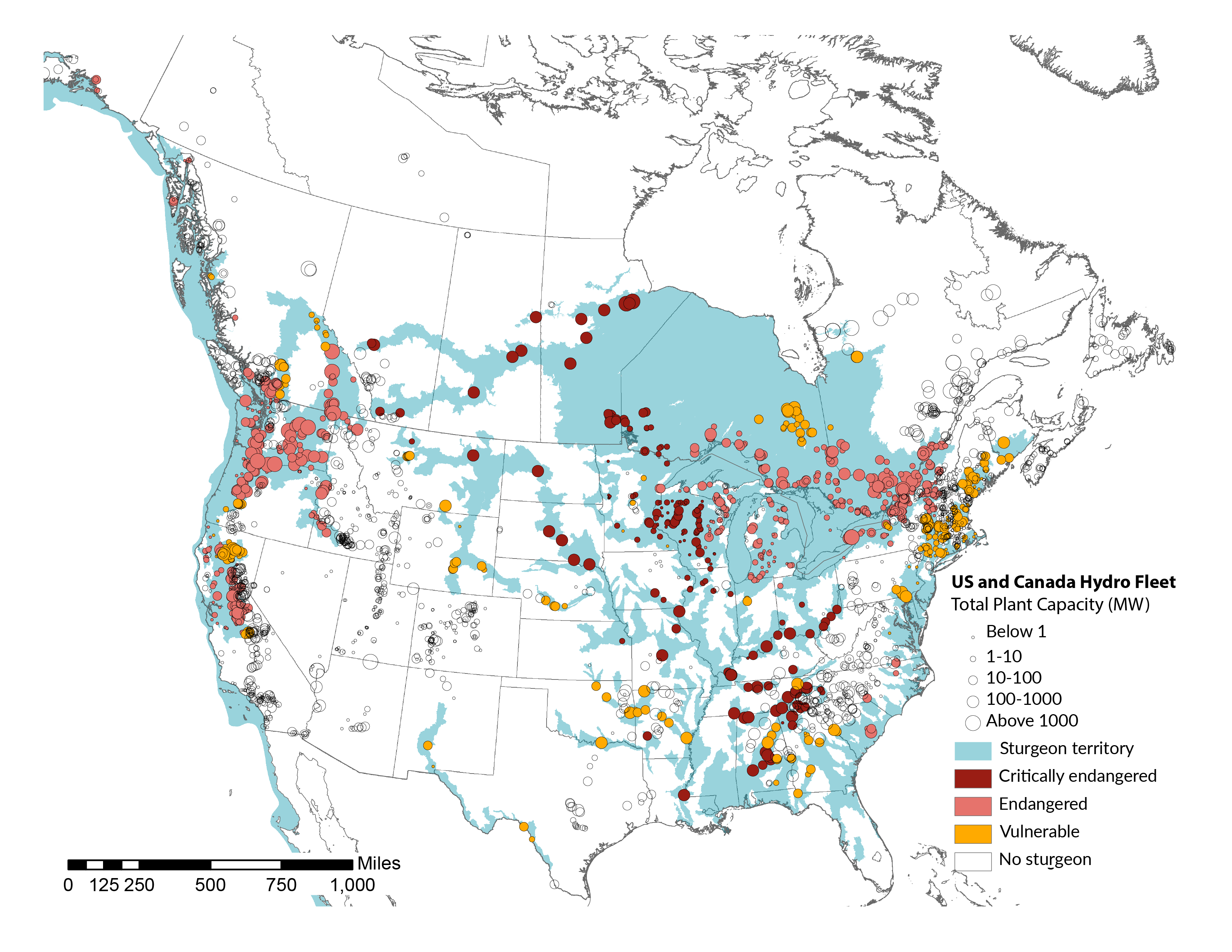
Sturgeon are among the oldest vertebrates on Earth, and now the most imperiled group of vertebrates on the planet. Nearly 70% of species are critically endangered, driven to the brink by habitat loss, overharvest, and, dams and hydropower turbines that fragment their migratory routes and kill and injure fish that pass through them.
At the same time, hydropower is one of the most important technologies we have for generating carbon-free electricity. Globally, it is the largest source of renewable energy, and it will play a central role in any transition away from fossil fuels. This creates a genuine tension: civilization needs clean power, and sturgeon need rivers they can move through safely.
This research program asks whether that tension can be resolved through better turbine design. Specifically, it tests whether a new generation of thick-bladed, fish-safe turbines can pass sturgeon with substantially lower rates of injury and mortality than conventional turbines. Furthermore, if fish survive, are there lasting sub-lethal harm that might affect their health, behavior, or reproductive success downstream.
Why This Matters
When a fish passes through a hydropower turbine, the most immediately dangerous event is blade strike — physical contact with the rotating runner. The severity of that strike depends on blade speed, blade thickness, the angle of impact, and the size of the fish. Conventional turbines are designed to move water efficiently, with thin, fast-moving blades that are damaging to fish. Fish-safe turbines take a different approach: thicker blades moving at lower peripheral speeds, designed to push rather than cut.
This study directly compared acute mortality and injury rates in sturgeon passed through a conventional thin-bladed turbine runner versus a thick-bladed fish-safe runner, under controlled experimental conditions. The goal was to produce the first rigorous empirical test of whether fish-safe turbine design actually delivers meaningfully better outcomes for one of the most vulnerable fish groups in North America.
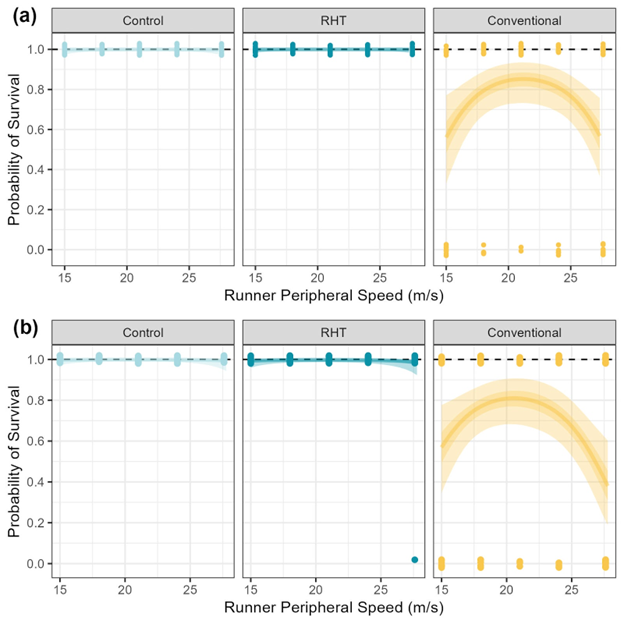
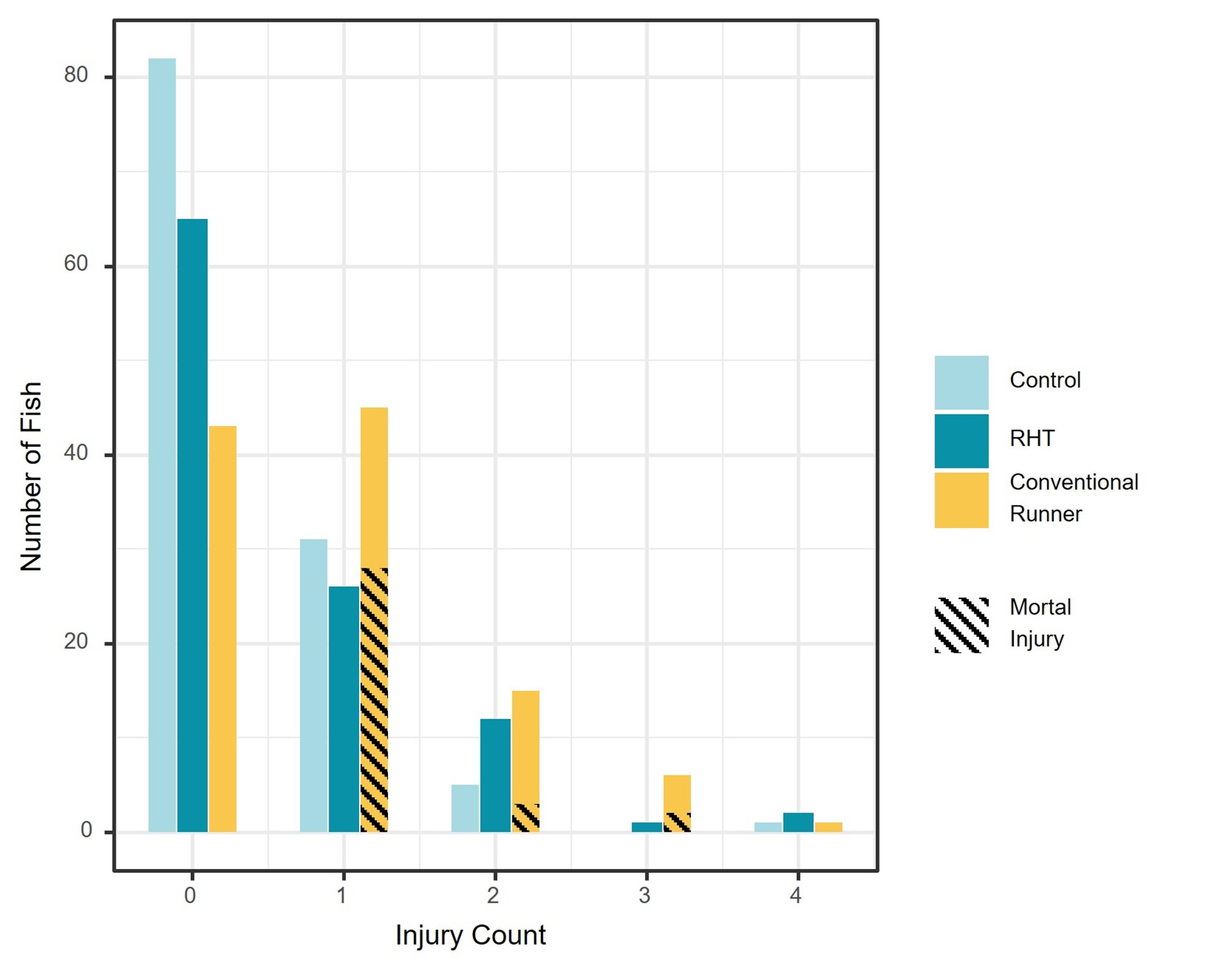
Sturgeon were passed individually through each turbine type at a range of operational conditions, and assessed for acute mortality and a standardized suite of external and internal injuries immediately after passage. The comparison was structured to isolate the effect of blade design from other variables — allowing a clean test of the core engineering claim underlying fish-safe turbine technology.
The fish-safe turbine produced significantly lower rates of acute mortality and severe injury compared to the conventional turbine. These results provide direct empirical support for the fish-safe turbine concept and establish a quantitative baseline for what passage outcomes are achievable with improved turbine design. The findings have implications for turbine selection, regulatory standards, and the feasibility of retrofitting existing hydropower infrastructure to reduce fish mortality.
An interactive tool for exploring turbine passage survival and injury outcomes across species, turbine types, and operational conditions.
Interactive data explorer coming soon
Replace this with your ShinyApps.io iframe when ready
Acute mortality is the most visible outcome of turbine passage, but it may not be the most biologically important one. A fish that survives passage but sustains internal injuries, physiological stress, or behavioral disruption may still suffer reduced fitness — with consequences for growth, migration success, and reproduction that are invisible in a standard survival trial.
For long-lived, late-maturing species like sturgeon, sub-lethal effects may matter enormously. A female sturgeon that survives turbine passage but fails to successfully spawn as a result of physiological damage represents a significant conservation loss — one that would never be counted in an acute survival study.
This portion of the project investigates the sub-lethal consequences of turbine passage in sturgeon, including stress physiology, injury healing trajectories, and impacts on downstream biological performance. By tracking fish beyond the immediate post-passage window, this work aims to characterize the full scope of turbine-related harm — and to determine whether fish-safe turbine designs reduce sub-lethal impacts as well as acute ones.
Manuscripts from this work are in preparation. Stay tuned.
Peer-reviewed papers arising from this research program
Zillig, K. W., Lassar, S. S., Watson, S. M., Baird, S. E., Schneider, A. D., Fangue, N. A. Comparison of juvenile white sturgeon blade strike survival through a conventional and a novel hydropower turbine.
Journal of Ecohydrology
Download PDF →