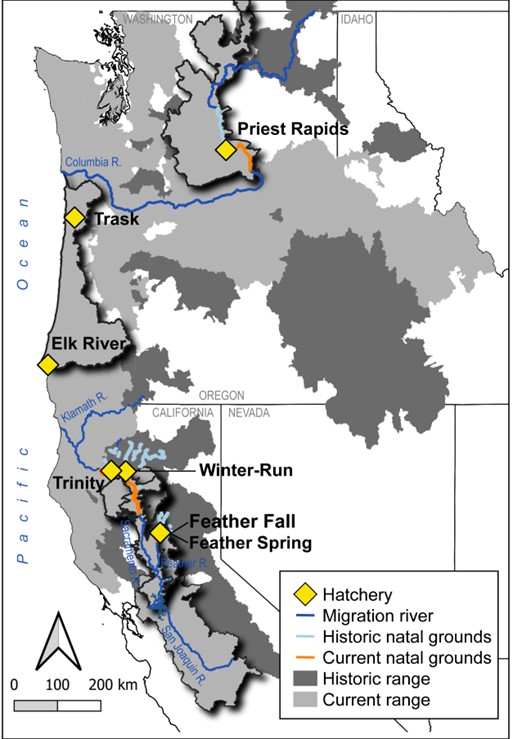
Are California's Chinook salmon populations physiologically distinct — and does that matter for their survival under a warming climate?
Chinook salmon (Oncorhynchus tshawytscha) are one of California's most ecologically and culturally important species — and one of the most imperilled by climate change. As rivers warm, questions about which populations can tolerate higher temperatures, and why, have become urgent management priorities.
My dissertation research tackled this question at scale, designing and conducting some of the largest metabolic performance experiments ever performed on teleost fishes. Working across eight hatchery populations spanning California's diverse river systems, I measured aerobic scope, thermal performance curves, and critical thermal maxima to ask whether populations differ physiologically — and whether those differences reflect local adaptation to historical thermal environments.
The answer was a clear yes. Populations differ substantially in how they perform across a temperature gradient, in ways that are consistent with adaptation to local conditions. These findings have direct implications for how we prioritize conservation and manage water for salmon under ongoing climate warming.
California's Chinook salmon are not one fish — they are many physiologically distinct populations that cannot be managed as though they were interchangeable.
This body of work shifts the conversation in salmon conservation from species-level thermal thresholds toward population-specific physiological profiles — a more accurate and ultimately more protective framework for management under climate change.
Before embarking on empirical work, it was essential to understand what was already known about thermal variation in salmonid physiology. This review synthesized the existing literature on thermal performance across Pacific salmon species and populations, with a focus on whether and how physiology varies with thermal environment.
We reviewed studies measuring aerobic scope, critical thermal maxima, gill oxygen uptake, and other performance metrics across multiple salmonid species and populations, synthesizing findings across California river systems and the broader Pacific coast.
The review revealed substantial — and systematically underappreciated — variation in thermal physiology among and within salmonid species. Critically, this variation was not random: it tracked historical thermal environments in ways consistent with local adaptation. The review identified major gaps in the literature, particularly around intraspecific (within-species, among-population) variation, and laid the conceptual groundwork for the empirical studies that followed.
This paper has since become a key reference for California salmon management and for researchers designing population-level physiological assessments.
Eight hatchery populations of juvenile Chinook salmon were acclimated to a common set of temperatures and measured for aerobic scope — the difference between maximum and resting metabolic rate — across a thermal gradient spanning their ecologically relevant temperature range.
This is one of the largest metabolic performance experiments conducted on any teleost fish, involving hundreds of respirometry trials across populations and temperatures. All fish were treated identically in terms of acclimation, feeding, and measurement protocols, ensuring that observed differences reflect true physiological divergence rather than environmental conditioning.
Populations showed clear and statistically significant differences in their thermal performance curves. Populations from historically warmer river systems tended to have higher optimal temperatures for aerobic performance and maintained aerobic scope at higher temperatures than populations from cooler systems. This pattern is consistent with local thermal adaptation — fish are physiologically tuned to the temperatures they evolved in.
Importantly, no single population performed best across all temperatures, suggesting real trade-offs in thermal specialization.
California's Chinook salmon are divided into four seasonal "runs" — winter, spring, fall, and late-fall — that differ in their timing of ocean entry, river migration, and spawning. These runs encounter very different temperature regimes during their freshwater residency, providing a natural experiment in thermal adaptation.
This study compared thermal physiology among populations representing each seasonal run, using the same aerobic scope framework as Study 02 but with a focus on whether run-timing is associated with distinct physiological profiles.
Seasonal runs did show physiological differences consistent with the temperatures they encounter during their freshwater life stages. Winter-run Chinook — which migrate and rear in the coldest conditions and are listed as Endangered — showed the lowest thermal optima and the greatest sensitivity to warming temperatures, highlighting their particular vulnerability to climate change.
These findings provide a physiological basis for understanding why different runs respond differently to thermal stress, and why a one-size-fits-all thermal threshold for water management is insufficient.
This study moved beyond aerobic scope to examine acute thermal tolerance — how much heat fish can withstand over a short period before losing equilibrium. Critical thermal maximum (CTmax) was measured across populations using standardized ramping protocols. Critically, the same fish used for aerobic scope measurements were also assessed for CTmax, allowing direct examination of the relationship between these two performance traits.
As with aerobic scope, populations differed significantly in CTmax, and these differences tracked historical thermal environments. However, the study also revealed an important physiological trade-off: populations with higher CTmax did not necessarily have better aerobic performance at high temperatures, and vice versa. These traits appear to be at least partially independent, reflecting distinct underlying mechanisms.
This has important implications for conservation: a population that can survive a brief heat spike may still suffer physiological costs that impair its long-term growth and reproduction under chronic warming. Management strategies that rely solely on lethal temperature thresholds may underestimate risk.
Peer-reviewed papers arising from this research program
Zillig, K. W., Bell, H. N., FitzGerald A.M., Fangue, N.A. Patterns of Interpopulation Variation and Physiological Trade-offs in the Acute Thermal Tolerance of Juvenile Chinook Salmon (Oncorhynchus tshawytscha).
Frontiers in Fish Biology
Zillig, K. W., FitzGerald, A. M., Lusardi, R. L., Cocherell D. E., Fangue, N. A. Intraspecific variation among Chinook salmon populations indicates physiological adaptation to local environmental conditions.
Conservation Physiology, 11(1)
Zillig, K. W., Lusardi, R. L., Cocherell D. E., Fangue, N. A. Interpopulation variation in thermal physiology among seasonal runs of Chinook salmon.
Canadian Journal of Fisheries and Aquatic Sciences
Zillig, K.W., Lusardi, R.A., Moyle, P., Fangue, N.A. One-size does not fit all: variation in thermal eco-physiology among Pacific salmonids.
Reviews in Fish Biology and Fisheries, 31(1)
An interactive tool for exploring thermal performance curves across Chinook salmon populations — compare aerobic scope, optimal temperatures, and CTmax across river systems.
Interactive data explorer coming soon
Replace this with your ShinyApps.io iframe when ready
Most populations — winter-run excepted — showed surprising thermal tolerance under controlled conditions. This gap between laboratory performance and field outcomes drove a new research focus: the ecological constraints that make high temperatures lethal even when the physiology says they shouldn't be.
At temperatures that are sublethal but physiologically costly, are salmon more vulnerable to predation — and do thermally advantaged predators exploit this window? This project examines how temperature-dependent performance mismatches between prey and predator shape realized mortality in the wild.
→In drought years, food limitation and thermal stress co-occur in California rivers. If salmon are energetically constrained, does their thermal tolerance collapse? This multi-year study tests how nutritional stress interacts with temperature to reshape physiological performance — and what it means for bioenergetic models used in water management.
→Laboratory performance curves describe potential — not realized — performance. This work bridges the gap by examining how biotic and abiotic field conditions modify the thermal sensitivity measured in the lab, and what that means for predicting population-level outcomes from physiological data.
→Peer-reviewed papers arising from this research program
Zillig, K. W., Bell, H. N., FitzGerald A.M., Fangue, N.A. Patterns of Interpopulation Variation and Physiological Trade-offs in the Acute Thermal Tolerance of Juvenile Chinook Salmon (Oncorhynchus tshawytscha).
Frontiers in Fish Biology
Zillig, K. W., FitzGerald, A. M., Lusardi, R. L., Cocherell D. E., Fangue, N. A. Intraspecific variation among Chinook salmon populations indicates physiological adaptation to local environmental conditions.
Conservation Physiology, 11(1)
Zillig, K. W., Lusardi, R. L., Cocherell D. E., Fangue, N. A. Interpopulation variation in thermal physiology among seasonal runs of Chinook salmon.
Canadian Journal of Fisheries and Aquatic Sciences
Zillig, K.W., Lusardi, R.A., Moyle, P., Fangue, N.A. One-size does not fit all: variation in thermal eco-physiology among Pacific salmonids.
Reviews in Fish Biology and Fisheries, 31(1)